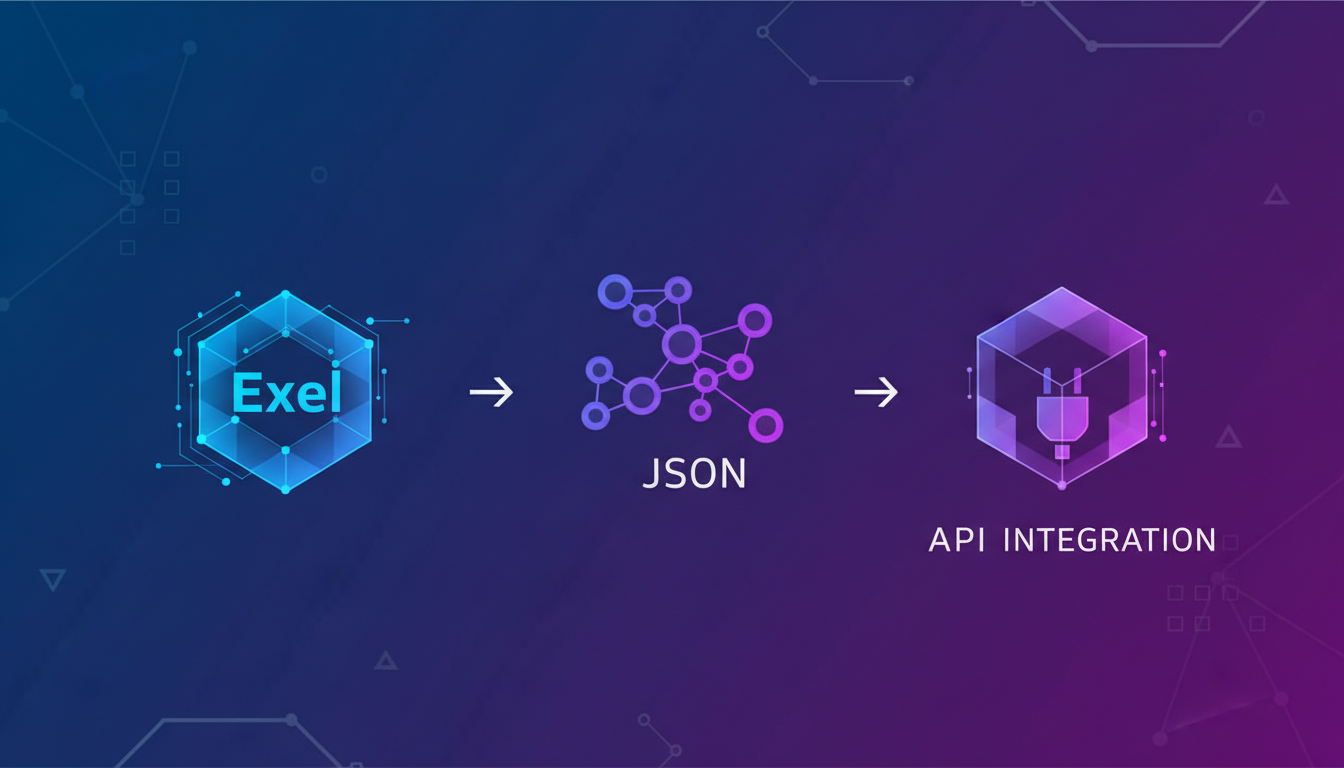
How to Convert Excel to JSON for API Integration
## How to Convert Excel to JSON for API Integration

## Introduction

In today's data-driven world, APIs (Application Programming Interfaces) are the backbone of seamless data exchange between different applications.  A common challenge arises when data is stored in a static format like Microsoft Excel and needs to be integrated with a dynamic API that expects data in JSON (JavaScript Object Notation). Excel, while excellent for data storage and manipulation, isn't directly compatible with most modern APIs. This post will provide a comprehensive guide on how to bridge this gap, transforming your Excel spreadsheets into JSON format for effortless API integration. We'll cover various methods, from using programming languages like Python to leveraging online converters and exploring the advantages and disadvantages of each approach. By the end of this tutorial, you'll be equipped with the knowledge and tools necessary to seamlessly integrate your Excel data with any API. Whether you are a seasoned developer or just starting your journey, this guide provides practical, step-by-step instructions and best practices to ensure a smooth and efficient conversion process.

## Why This Matters

The ability to convert Excel data to JSON is crucial for several reasons, especially when working with APIs.  APIs are designed to communicate in structured formats, and JSON has become the de facto standard due to its simplicity, readability, and widespread support across different programming languages and platforms.  Imagine you have a product catalog in an Excel sheet. To display this catalog on a website or mobile app using an API from an e-commerce platform, you need to transform the Excel data into JSON. This allows the API to easily understand and process the data, enabling you to dynamically update your product listings. Without this conversion, integration becomes significantly more complex and often requires writing custom, inefficient parsing logic. Further, using JSON ensures data consistency and avoids potential errors that could arise from using less structured data formats. In short, mastering the Excel to JSON conversion process unlocks the power of APIs, streamlining data exchange and enabling efficient application integration.

## Complete Guide

Here's a detailed, step-by-step guide on converting Excel to JSON, covering multiple methods:

**Method 1: Using Python with Pandas and `json` libraries**

Python is a versatile language ideal for data manipulation and transformation. The Pandas library provides excellent functionality for reading and working with Excel data, while the `json` library allows you to serialize Python objects into JSON strings.

**Step 1: Install Required Libraries**

First, make sure you have Pandas and the `json` library installed.  Since `json` is a built-in Python library, you likely already have it. Install Pandas using pip:

```bash
pip install pandas openpyxl
(The openpyxl library is necessary for reading .xlsx files).
Step 2: Load Excel Data into a Pandas DataFrame
import pandas as pd
excel_file = 'your_excel_file.xlsx'
df = pd.read_excel(excel_file, sheet_name='Sheet1')
print(df)
Step 3: Convert DataFrame to JSON
Pandas offers a direct method to convert a DataFrame to JSON using the to_json() function.
import pandas as pd
excel_file = 'your_excel_file.xlsx'
df = pd.read_excel(excel_file, sheet_name='Sheet1')
json_data = df.to_json(orient='records')
print(json_data)
Explanation of orient parameter:
The orient parameter in to_json() controls the structure of the resulting JSON. Here are a few commonly used options:
'records': Generates a JSON array of objects, where each object represents a row in the DataFrame. This is typically the most useful format for API integration. (e.g., [{"column1": "value1", "column2": "value2"}, {"column1": "value3", "column2": "value4"}])'index': Generates a JSON object where the keys are the DataFrame index, and the values are objects representing each row.'columns': Generates a JSON object where the keys are the DataFrame column names, and the values are arrays representing the column data.'values': Generates a JSON array of arrays, where each inner array represents a row in the DataFrame.
Step 4: (Optional) Save the JSON to a File
import pandas as pd
import json
excel_file = 'your_excel_file.xlsx'
df = pd.read_excel(excel_file, sheet_name='Sheet1')
json_data = df.to_json(orient='records')
with open('output.json', 'w') as f:
f.write(json_data)
print("JSON data saved to output.json")
Example Excel Data (your_excel_file.xlsx):
| Name | Age | City |
|---|
| Alice | 30 | New York |
| Bob | 25 | London |
| Charlie | 35 | Paris |
Corresponding JSON Output (using orient='records'):
[
  {"Name":"Alice","Age":30,"City":"New York"},
  {"Name":"Bob","Age":25,"City":"London"},
  {"Name":"Charlie","Age":35,"City":"Paris"}
]
Method 2: Using Online Converters
Several online tools allow you to convert Excel to JSON without writing any code. Some popular options include:
- ConvertCSV.com: This website offers a simple and direct Excel to JSON converter. You upload your file, specify the desired output format, and download the resulting JSON.
- JSON-CSV.com: Another online tool that supports various conversion formats, including Excel to JSON.
- Various other free online converters: A simple web search for "excel to json converter" will return numerous options.
Pros:
- Easy to use, requiring no programming knowledge.
- Quick and convenient for small files.
Cons:
- Security concerns: Uploading sensitive data to a third-party website might be risky.
- Limited customization options compared to programmatic solutions.
- File size limitations: Free online converters often have restrictions on the size of the Excel file.
- Dependence on internet connectivity.
Method 3: Using Google Sheets Scripting
Google Sheets offers a scripting environment (Google Apps Script) that allows you to automate tasks and manipulate data. You can write a script to read data from a Google Sheet and convert it to JSON.
Step 1: Open your Excel file in Google Sheets
Upload your Excel file to Google Drive and open it with Google Sheets.
Step 2: Open the Script Editor
Go to "Tools" > "Script editor."
Step 3: Write the Google Apps Script
function excelToJson() {
var ss = SpreadsheetApp.getActiveSpreadsheet();
var sheet = ss.getActiveSheet();
var data = sheet.getDataRange().getValues();
var header = data[0];
var jsonData = [];
for (var i = 1; i < data.length; i++) {
var row = data[i];
var obj = {};
for (var j = 0; j < header.length; j++) {
obj[header[j]] = row[j];
}
jsonData.push(obj);
}
Logger.log(JSON.stringify(jsonData));
}
Step 4: Run the Script
Click the "Run" button (the play icon). You might be prompted to authorize the script to access your Google Sheet.
Explanation:
- The script reads the data from the active sheet.
- It extracts the first row as the header (column names).
- It iterates through each subsequent row, creating a JSON object for each row, with column names as keys and row values as values.
- It logs the generated JSON data to the execution log. You can view the log by going to "View" > "Logs."
- The commented-out line can be used to write the JSON data to a cell in the sheet.
Method 4: Using Dedicated Spreadsheet Software with JSON Export
Some spreadsheet software, beyond Excel, offers built-in JSON export functionality. For instance, some open-source alternatives to Excel have this feature. Check the documentation for the spreadsheet program you are using to see if JSON export is supported.
Best Practices
- Data Validation: Before converting, ensure your Excel data is clean and consistent. Missing values, incorrect data types, and inconsistent formatting can lead to errors in the JSON output.
- Choose the Right
orient Parameter (Pandas): Select the orient parameter in the Pandas to_json() function that best suits your API's expected JSON structure. 'records' is often the most convenient, but other options may be necessary depending on the API's requirements.
- Handle Dates and Numbers: Excel stores dates as numbers. When converting to JSON, these numbers might not be interpreted correctly. Use Pandas to format date columns before conversion (e.g.,
df['DateColumn'] = pd.to_datetime(df['DateColumn']).dt.strftime('%Y-%m-%d')). Similarly, handle numeric formatting to avoid unexpected decimal places or scientific notation.
- Error Handling: Implement error handling in your code to gracefully handle potential issues like file not found errors, incorrect sheet names, or data type conversion problems.
- Sanitize Data: If your Excel data contains special characters or potentially harmful content, sanitize the data before converting it to JSON to prevent security vulnerabilities. Consider HTML encoding or URL encoding as appropriate.
- Test Your API Integration: After converting the data, thoroughly test your API integration to ensure that the JSON data is being correctly processed and that the API is functioning as expected. Use a tool like Postman to send sample JSON data to your API endpoint and verify the response.
- Documentation: Document your conversion process, including the steps involved, the code used, and any specific data transformations performed. This will help you maintain and troubleshoot the integration in the future.
- Consider Performance: For large Excel files, programmatic solutions like Python with Pandas are generally more efficient than online converters. If performance is critical, optimize your code and consider using techniques like chunking to process the data in smaller batches.
Common Mistakes to Avoid
- Forgetting to Install Required Libraries: Ensure you have all the necessary libraries installed before running your code (e.g., Pandas,
openpyxl).
- Incorrect File Path or Sheet Name: Double-check the file path to your Excel file and the sheet name. Typos are a common source of errors.
- Not Handling Missing Values: Decide how you want to handle missing values in your Excel data. Pandas will often represent missing values as
NaN. You can replace these with a specific value (e.g., an empty string or null) using the fillna() method before converting to JSON.
- Ignoring Data Types: Be mindful of data types. Excel might store numbers as strings or dates as numbers. Ensure that the data types are correctly converted to the appropriate JSON types.
- Overlooking Encoding Issues: If your Excel file contains characters outside the ASCII range (e.g., accented characters), ensure that your code handles encoding correctly. UTF-8 encoding is generally recommended.
- Blindly Trusting Online Converters: Be cautious about uploading sensitive data to online converters, especially if you don't know who owns the website.
- Not Validating the JSON Output: Always validate the generated JSON to ensure it is well-formed and conforms to the expected structure. You can use online JSON validators to check for syntax errors.
Industry Applications
The ability to convert Excel to JSON for API integration is vital across various industries:
- E-commerce: Updating product catalogs, managing inventory, and processing orders by integrating Excel-based data with e-commerce platforms.
- Finance: Importing financial data from Excel spreadsheets into accounting software or financial analysis tools via APIs.
- Healthcare: Transferring patient data or medical records from Excel sheets into Electronic Health Record (EHR) systems.
- Marketing: Automating email marketing campaigns or updating customer relationship management (CRM) systems with data from Excel.
- Logistics: Managing shipment tracking data and integrating it with logistics platforms.
- Education: Importing student records or course information into learning management systems (LMS).
In each of these scenarios, Excel acts as a convenient and familiar tool for data entry and organization. Converting this data to JSON allows for seamless integration with the more dynamic and interconnected world of APIs.
Advanced Tips
- Dynamic Sheet Selection: Modify the Python script to dynamically select the sheet to convert based on user input or a configuration setting.
- Filtering and Transforming Data: Use Pandas to filter and transform the data before converting it to JSON. You can apply complex logic to clean, reshape, and aggregate the data.
- Incremental Updates: Implement a mechanism to only convert and upload changes made to the Excel file since the last integration. This can improve performance and reduce the load on the API. This could involve tracking timestamps or using a checksum of the Excel file.
- Using API Authentication: When interacting with APIs, make sure you use proper authentication methods (e.g., API keys, OAuth) to secure your data and prevent unauthorized access.
- Asynchronous Processing: For large Excel files, consider using asynchronous processing to avoid blocking the main thread and improve the user experience.
FAQ Section
Q: What's the best way to handle date values in Excel when converting to JSON?
A: Dates in Excel are stored as numbers. Use Pandas to convert these numbers to datetime objects and then format them into a standard string format (e.g., YYYY-MM-DD) before converting to JSON.
Q: How do I handle missing values in my Excel data?
A: Use the fillna() method in Pandas to replace missing values with a specific value, such as an empty string ('') or null.
Q: Is it safe to use online Excel to JSON converters?
A: Be cautious when uploading sensitive data to third-party websites. Consider using a programmatic solution if security is a concern.
Q: How can I convert multiple Excel sheets to JSON?
A: You can iterate through the sheet names in the Excel file using Pandas and convert each sheet to a separate JSON file or combine them into a single JSON file.
Q: How do I handle large Excel files?
A: For large files, use programmatic solutions like Python with Pandas and consider chunking the data into smaller batches to improve performance.
Q: What is the orient parameter in Pandas to_json() function?
A: The orient parameter controls the structure of the resulting JSON. Common options include 'records', 'index', 'columns', and 'values'. Choose the option that best suits your API's expected JSON structure. 'records' is often the most useful.
Q: How do I include the column headers in the JSON output?
A: Using orient='records' with Pandas automatically includes the column headers as keys in the JSON objects.
Q: My JSON output isn't formatted nicely. How do I make it more readable?
A: In Python, you can use the indent parameter in the json.dumps() function to format the JSON output with indentation for better readability. When using Pandas to_json(), you can serialize the string with json.loads() and then json.dumps() with the indent parameter. For example:
import pandas as pd
import json
excel_file = 'your_excel_file.xlsx'
df = pd.read_excel(excel_file, sheet_name='Sheet1')
json_data = df.to_json(orient='records')
formatted_json = json.dumps(json.loads(json_data), indent=4)
print(formatted_json)
Conclusion
Converting Excel data to JSON is a fundamental skill for anyone working with APIs and data integration. This guide has provided a comprehensive overview of various methods, from using programming languages like Python to leveraging online converters and Google Sheets scripting. By understanding the strengths and weaknesses of each approach, following the best practices, and avoiding common mistakes, you can seamlessly integrate your Excel data with any API, unlocking new possibilities for automation, data sharing, and application integration. Whether you're a data analyst, a software developer, or simply someone who needs to bridge the gap between Excel and the world of APIs, the knowledge gained from this tutorial will empower you to tackle your data integration challenges with confidence.